
Chemical Peel vs. Laser for Acne Scars: How to Know Which One Is Right for Your Skin
If you’ve spent any time researching acne scar treatment in Toronto, you’ve probably run into the same two options: chemical peels and laser resurfacing. And if you’re like most people, the more you read, the less certain you feel.
That’s not a failure of research. It’s actually a sign that you’re asking the right question. Because the answer isn’t “one is better than the other.” The answer is: which treatment is best for acne scars depends on the specific scars you have, your skin tone, and the outcome you’re after.
This guide walks through both modalities clearly, what they do, what they’re best for, and what a realistic treatment plan looks like. By the end, you’ll have the clarity to walk into a consultation knowing exactly what to ask.
First, What Are You Actually Treating?
The reason treatment decisions can feel confusing is that not all acne scars behave the same way. And if you’re trying to treat the wrong thing with the wrong tool, you’ll plateau before you reach your goal.
Broadly, acne scars fall into two categories:.
Textural scars
These are the ones you can feel when you run a finger across your skin. Rolling scars create a wavy, uneven surface. Boxcar scars are wider depressions with defined edges. Ice-pick scars are deep, narrow channels that extend into the dermis. All three involve structural changes beneath the skin’s surface, not just the top layer.
Pigmented scars (PIH)
Post-inflammatory hyperpigmentation refers to flat, discoloured marks, pink, red, or brown, that linger long after a breakout clears. Technically not “true” scars, but for most people, they’re just as frustrating. They affect how the skin looks, even when the texture has improved. For many people, these lingering marks are what keep the skin from looking clear, even after breakouts have stopped.
Chemical peels and lasers work in fundamentally different ways, and they each do their best work on different problems. Knowing which type you’re primarily dealing with is the most useful thing you can do before your consultation.
How Chemical Peels Work
A chemical peel uses an acid solution, glycolic, salicylic, lactic, TCA, or a customized blend, to dissolve and lift the outer layers of skin. As the treated surface sheds, it’s replaced by newer skin underneath that’s smoother, more evenly toned, and better at reflecting light.
Peels work primarily at the surface level. That makes them particularly effective for:
• Post-inflammatory hyperpigmentation and uneven skin tone
• Mild surface texture and congestion
• Radiance, pore refinement, and overall skin clarity
• Pre-treatment skin preparation before laser resurfacing
Deeper formulations, such as TCA, can penetrate the mid-dermis and address more significant texture concerns. But they require longer recovery and more careful patient selection, particularly for clients with medium to deep skin tones.
At Emerald Skin Lab, our medical-grade chemical peels for acne scars in Toronto are customized to your specific scar profile and skin type. A single treatment can produce visible improvement in tone and clarity. Most clients see their best results over a series of sessions spaced a few weeks apart.
Downtime: Light peels involve minimal recovery, some redness and light flaking for a few days. Deeper peels may involve 7–10 days of visible peeling and require strict sun avoidance during healing.
How Laser Resurfacing for Acne Scars Works
Lasers work differently. Rather than chemically dissolving the surface, they deliver targeted energy into the skin to create controlled thermal injury. The goal is to trigger your skin’s natural healing response: collagen production, tissue remodelling, and the gradual filling-in of depressed scars from below.
This is why laser resurfacing for acne scars consistently outperforms peels when it comes to structural, textural scarring. Lasers reach deeper into the dermis and stimulate the kind of remodelling that actually changes the architecture of the scar, not just the surface above it.
At Emerald Skin Lab, we offer three laser options for acne scars. Each is suited to a different level of severity and recovery tolerance..
Fotona Laser
The Fotona Er:YAG laser is one of the most versatile platforms available for acne scar treatment. It can be delivered in ablative or non-ablative modes and adjusted for different scar depths, making it effective on rolling, boxcar, and ice-pick scars. Fotona acne scar treatment is also a strong option for patients who want meaningful structural improvement with a more controlled downtime profile than traditional ablative lasers.
It has a particularly strong safety record for melanin-rich skin, which matters significantly in treatment planning.
Typical plan: 2–3 sessions spaced 4–6 weeks apart.
Fraxel
Fraxel is a fractional laser, meaning it treats thousands of microscopic columns of skin while leaving surrounding tissue intact. This approach allows significant resurfacing results with faster healing than fully ablative lasers.
For clients in Toronto seeking Fraxel treatment, it’s particularly well-suited for diffuse scarring across larger areas, boxcar and rolling scars especially, and has a strong clinical track record for producing consistent density improvement.
Typical plan: 2–3 sessions spaced 4–8 weeks apart.
Laser Resurfacing
Full-field laser resurfacing delivers more aggressive treatment and is suited for patients with significant, widespread scarring who are prepared for a more involved recovery. It produces the most dramatic structural results and is typically reserved for cases where fractional treatment alone won’t achieve the desired outcome.
Downtime: Non-ablative: 1–3 days of redness. Fractional ablative: 5–7 days of redness, swelling, and peeling. Full resurfacing: up to two weeks, with careful post-treatment care.
The Skin Tone Conversation Nobody Should Skip
If you have a medium to deep skin tone, this is a non-negotiable part of your treatment planning. And it’s worth saying clearly: every skin tone can be treated safely when the protocol is right.
Both chemical peels and lasers carry a risk of post-inflammatory hyperpigmentation in darker skin tones when they’re not applied with the correct parameters. This is especially relevant when considering laser vs. peel for hyperpigmentation. The wrong approach can temporarily worsen the very concern you’re trying to address.
That’s not a reason to avoid treatment. It’s a reason to choose a clinic that takes it seriously.
At Emerald Skin Lab, skin tone is assessed as part of every acne scar consultation. For clients with deeper complexions, we typically incorporate a pre-conditioning phase before laser treatment, a pigment-suppression routine using topical agents that calm melanin activity in the skin and reduce the risk of post-treatment discolouration. This step is often skipped at less specialized clinics, and it makes a meaningful difference in both safety and results.
We also lean toward Fotona’s Er:YAG platform for melanin-rich skin, which has a strong, established safety profile and gives our team precise control over energy delivery. The goal is always effective treatment, without trading one pigmentation concern for another.
Why the Best Results Usually Come from Combining Both
Here’s something that often surprises people who’ve been deep in research mode: the question isn’t always “peel or laser.”
For patients with a mixed scar burden, both pigmentation and texture, both surface and structural, a combination acne scar treatment produces the most comprehensive results. Treating only one layer of the problem leaves the other untouched.
A typical combination protocol at Emerald Skin Lab might look like this:
• A pre-treatment phase using chemical peels to address PIH, reduce surface irregularity, and prime the skin for laser
• Fractional laser (Fotona or Fraxel) targeting the structural scarring beneath the surface
• A maintenance peel or medical-grade skincare protocol to protect and prolong the results
Results are cumulative. Most people see meaningful improvement after each session, with the most significant changes becoming visible at the 3–6 month mark as collagen remodelling continues below the surface.
Treating significant acne scarring is a planned sequence, not a single appointment. The good news is that each step moves you forward.
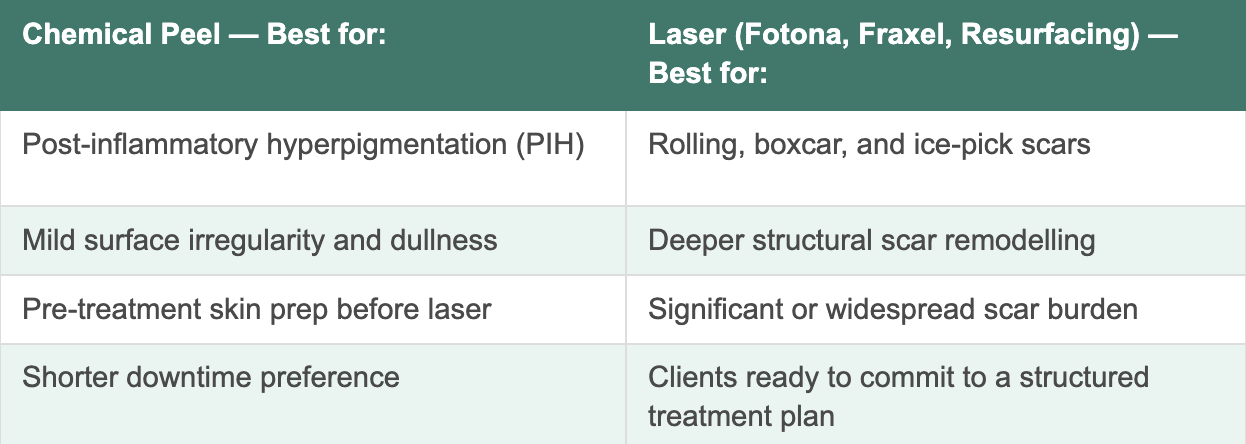
Quick Reference: Chemical Peel vs. Laser at a Glance
What Happens at Your Consultation
One of the most common mistakes people make when researching acne scar treatment in North York or Toronto is trying to select a treatment before anyone has actually assessed their skin. It’s completely understandable. You’ve done the research, you want a clear path forward. But scar type, depth, distribution, and skin tone all influence the plan, and they can’t be evaluated from a photo.
At your acne scar consultation at Emerald Skin Lab, here’s what to expect:
Scar assessment: We identify your scar types (PIH, rolling, boxcar, ice-pick) and document the distribution across your face
Skin tone evaluation: We assess your Fitzpatrick type and determine whether pre-conditioning is appropriate before any laser treatment
Device and modality selection: We match your scar profile to the right tool: peel, Fotona, Fraxel, full resurfacing, or a combination
Timeline and session planning: We map out a realistic sequence, including spacing between treatments and when to expect visible results
Downtime discussion: We align the treatment intensity with your schedule and life, not just your skin
No pressure, no guesswork. Just an honest conversation about what your skin actually needs, and a plan you can feel confident moving forward with.
Ready to Move Forward?
If you’ve been sitting on this decision, this is a good time to act on it. Acne scars don’t resolve on their own, but with the right protocol, they do respond. Most people who come in feeling uncertain about where to start leave with a clear picture of exactly what’s possible for their skin.
Your skin has already done the hard work of clearing. Now it’s our job to help it recover fully.
