
Understanding Laser Options for Sun Spots, Age Spots, Hyperpigmentation & More
Dark spots are one of the most common concerns we see at Emerald Skin Lab, and also one of the most frequently misunderstood. Patients arrive having tried vitamin C serums, brightening creams, and over-the-counter treatments for months or years, with limited results. Others have researched laser treatment online and find themselves confronted with a long list of device names, wavelengths, and conflicting information about which approach is best.
The answer is more nuanced than it may first appear, because not all dark spots are the same condition, and not all laser treatments work in the same way. Understanding that distinction is the foundation of treatment that actually delivers results.
Not All Dark Spots Are the Same
Visible pigmentation on the skin has several possible origins, and each behaves differently in response to treatment. The most common types we assess at our clinic are:
Solar Lentigines (Sun Spots)
Solar lentigines are flat, well-defined spots that develop on areas of skin with cumulative sun exposure, typically the face, chest, shoulders, and hands. They form when melanocytes (pigment-producing cells) respond to UV damage by producing localized concentrations of melanin. They tend to have clear borders and a relatively uniform colour, and they respond well to targeted laser treatment when the correct wavelength is used.
Age Spots
Age spots, sometimes used interchangeably with sun spots, though not identical, tend to appear in later decades and often reflect a combination of cumulative UV exposure and the skin’s reduced ability to turn over and repair itself efficiently. They may appear in clusters and vary somewhat in depth and tone. Like solar lentigines, they are generally responsive to laser treatment, though the approach may vary depending on their depth and the degree of surrounding skin damage.
Melasma
Melasma is a distinct condition that is often confused with sun damage. It appears as larger, more diffuse patches of pigmentation, commonly across the cheeks, upper lip, and forehead, and is driven by hormonal factors alongside UV exposure. It is significantly more complex to treat than solar lentigines and is prone to rebound darkening when the skin is subjected to heat, trauma, or UV exposure without careful management. Laser treatment can help with melasma, but it requires a more cautious, specialized protocol. Treating melasma as though it were a simple sun spot can worsen the condition.
Post-Inflammatory Hyperpigmentation (PIH)
PIH occurs when the skin produces excess melanin in response to inflammation, following acne, eczema, irritation, or even an overly aggressive skincare treatment. It tends to present as flat discolouration following a healed skin event, and its depth within the skin layers will vary. PIH generally fades over time on its own, though the process can be slow. Professional treatment may help accelerate recovery, but the approach needs to account for the underlying cause to avoid triggering further inflammation and additional pigmentation.
Why getting the diagnosis right matters
Using the wrong treatment on the wrong type of pigmentation is one of the most common reasons people feel their laser or light treatment “didn’t work” or made things worse. Melasma, in particular, can rebound significantly when treated with aggressive heat-based devices without appropriate preparation and aftercare. A clinical assessment to identify the type and depth of pigmentation is always the first step at Emerald Skin Lab, before any treatment recommendation is made.
How Laser Treatment Targets Pigmentation
Laser devices designed for pigmentation work on the principle of selective photothermolysis, whereby specific wavelengths of light are selectively absorbed by melanin (the pigment molecule) while leaving surrounding tissue largely unaffected. When melanin absorbs the laser’s energy, it fragments into smaller particles that the body’s immune system can gradually clear.
The effectiveness of any given laser for pigmentation depends on the wavelength used, the depth the laser reaches within the skin, the pulse duration, and how the device manages heat. Different types of pigmentation sit at different depths within the skin, which is one reason why device selection matters considerably.
At Emerald Skin Lab, we use two advanced laser platforms that each offer distinct advantages for treating pigmentation: the Fotona SP Dynamis and the Fraxel system. Each is suited to different presentations, and the choice between them, or a combination of both, depends on what the assessment reveals.
Fotona SP Dynamis Nd:YAG 1064nm for Deep Melanin Deposits
The Fotona SP Dynamis is a multi-application laser system that includes an Nd:YAG 1064nm wavelength, which is particularly effective for targeting deeper melanin deposits. The 1064nm wavelength penetrates more deeply than shorter wavelengths, making it well-suited for pigmentation that sits beneath the skin’s surface, including stubborn age spots, deeper solar lentigines, and certain presentations of melasma that have a dermal component.
The Nd:YAG wavelength is also considered one of the safer options for treating pigmentation in a wider range of skin tones, as it carries a lower risk of causing post-inflammatory hyperpigmentation in darker complexions compared to some other laser options. This is a meaningful clinical consideration that affects which patients are appropriate candidates for which devices.
The Fotona system also allows for precise pulse control, which gives the treating clinician the ability to calibrate energy delivery to the depth and concentration of pigmentation being addressed rather than applying a fixed protocol uniformly across the skin.
Fraxel: Fractional Resurfacing for Widespread Sun Damage and Uneven Tone
For patients presenting with more diffuse sun damage, widespread uneven tone, texture changes, and pigmentation that extends across larger areas of the face or body, fractional laser resurfacing with the Fraxel system may be a more appropriate approach.
Fraxel works by delivering laser energy in thousands of microscopic columns across the treatment area, creating controlled zones of thermal injury while leaving surrounding tissue intact. This stimulates a healing response that supports new collagen production and accelerated skin cell turnover. Over a series of treatments, this can lead to gradual improvements in overall skin tone, texture, and clarity, including a reduction in the appearance of diffuse pigmentation.
Fractional resurfacing tends to require more recovery time than targeted spot treatment, but it addresses a broader range of concerns simultaneously and is often well-suited to patients whose primary complaint is overall photodamage rather than isolated spots.
What to expect after treatment: the darkening phase
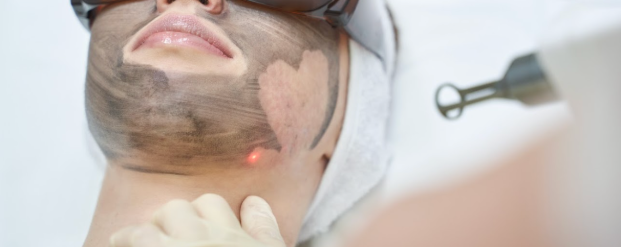
One aspect of laser pigmentation treatment that frequently surprises patients is that treated spots typically appear darker for several days following the procedure before they begin to fade. This is a normal and expected part of the process; the laser has fragmented the melanin, and as the skin begins its response, the pigment temporarily rises to the surface before being shed. Patients who aren’t prepared for this can become alarmed and assume the treatment has made things worse. It hasn’t. The darkening phase is, in most cases, a sign the treatment is working as intended. Your clinician will explain what to expect for your specific treatment before you leave the clinic.
The Role of a Clinical Assessment
Given the number of variables involved pigmentation type, depth, skin tone, treatment history, and individual healing response a thorough clinical assessment is the most important step before any laser treatment for dark spots. The goal is not simply to choose a laser device, but to understand what is actually happening within the skin and develop a treatment plan based on those findings.
At Emerald Skin Lab, a pigmentation assessment involves a detailed review of your skin’s history, a clinical evaluation of the type and likely depth of pigmentation, and an honest conversation about what laser treatment can reasonably achieve for your specific presentation, including realistic timelines, the number of sessions that may be needed, and what maintenance typically looks like after treatment.
Where melasma or PIH is identified, the assessment will also include a discussion of how to manage the condition alongside treatment, including the role of sun protection, any topical preparation that may be recommended beforehand, and the importance of aftercare in preventing rebound.
Book a pigmentation assessment at Emerald Skin Lab
If you’ve been managing visible dark spots, sun damage, or uneven tone without meaningful improvement from topical products, a clinical assessment is a useful starting point. Our team in North York works with both the Fotona SP Dynamis and Fraxel systems and can help determine which approach, or which combination, is most appropriate for your skin. Consultations are available for new patients and include a full skin review before any treatment recommendation is made.
A More Informed Starting Point
Laser treatment for pigmentation can produce meaningful, lasting improvement — but success depends on an accurate diagnosis, an appropriate treatment plan, and realistic expectations. Understanding the type of pigmentation being treated is the foundation of effective care, and it is what everything else builds from.
If you’re considering laser treatment for sun spots, age spots, melasma, or other forms of pigmentation, a consultation can help determine what type of pigmentation is present and whether laser treatment or another approach is likely to provide the best outcome for your skin.
